End-of-Life requests for religious rituals are the most impactful events that occur in a temple minister’s daily life, both in terms of disruption of one’s “routine” and the minister’s personal spiritual journey.
For the family, the decision to move a loved one from “treatment” to “palliative” care, from “hospital” to “hospice,” is often emotionally and physically overwhelming, which triggers a series of more decisions, details, and procedures.
To truly accept a loved one has reached the end of life is the most difficult of difficulties.
Spiritual care and being a compassionate presence is an important part of hospice care: the doctors and nurses ensure the loved one is kept as comfortable as possible, while spiritual caregivers like priests, ministers, chaplains, and trained volunteers help the patient and family accept the great changes and challenges they face.
Jōdo Shinshū Hongwanji-ha doctrine is very clear that religious “ritual” in and of itself has no supernatural powers—whether an ordained priest chants sutra, or not makes no difference in terms of the loved one’s going forth to Birth into the Pure Land, becoming a Buddha, and returning in Oneness with Amida as NamoAmidaButsu! to guide all beings to Birth. Amida takes care of all of that! NamoAmidaButsu!
So, why call a Buddhist priest when a loved one is at end-of-life?
In my experience, the loved one in the hospice bed is very aware of what is going on; who is with them; they sense the sorrow and sadness of the family and friends; they simply cannot respond in ways we can understand.
Invariably, when I set up the altar with flowers, candle, incense, ring the bell, and begin chanting, the loved one will respond in some way: opening eyes, moving hands, trying to say “NamoAmidaButsu!”
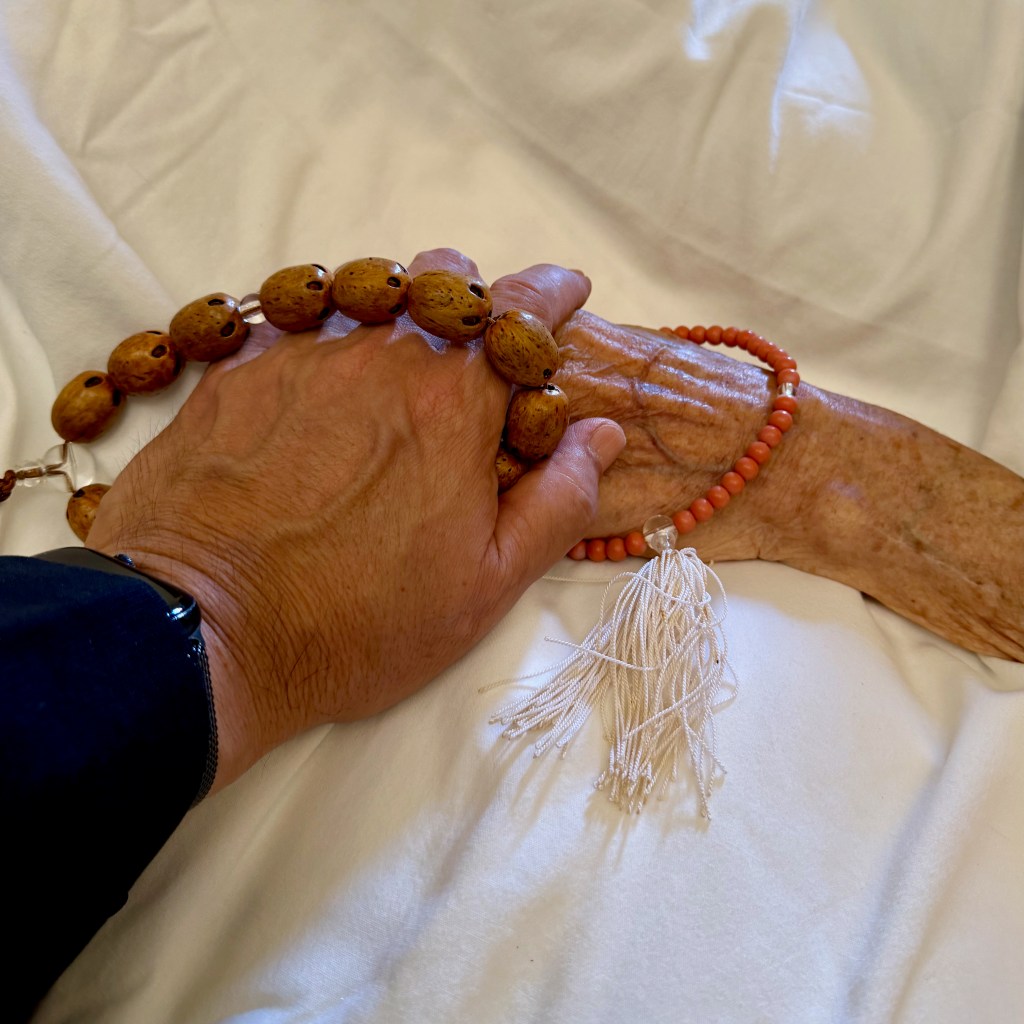
During the chanting, I encourage the family members to hold the hands and touch the face of their loved one; to whisper quietly, “I love you!” “Thank you for being in my life!”
Reality-as-it-is: it is the loved one in the bed who creates the time, place, and occasion to re-connect with our love and emotions—Our loved ones are preparing us for the inevitable.
“Ritual” simply gives us permission to express our love and gratitude.
The end-of-life of another person helps us to truly realize Amida’s Great Compassion is real, even if we can’t understand or explain it! NamoAmidaButsu!
Thus, religious ritual can bring comfort and familiarity to the loved one in hospice care and strength and serenity to the family and friends who are facing the loss of a loved one, a dear friend, a beloved uncle or aunty. NamoAmidaButsu!
Yet, when the end of life comes, it is always a shock.
One of my mentor sensei, Rev. Art Kaufmann, taught me, “ritual is what we do when we are so overwhelmed with sadness, we just don’t know what else to do”.
The brief time used to conduct religious ritual gives the family and friends a chance to truly experience their loss and sadness in that moment, creating a sacred space in which we begin to understand truly and begin to appreciate just how much the loved one meant to us, a time we can express our gratitude.
For Shin Buddhists, our hearts are filled with both sorrow at the reality-as-it-is of death, and joy for the assurance of Birth into the Pure Land for our loved ones.
Through the sadness of end-of-life, we are brought to realize the preciousness of this moment of this day of an unrepeatable life. NamoAmidaButsu!
We are brought to truly appreciate the presence of kind and gentle people in our lives. NamoAmidaButsu!
We are brought to joyful acceptance of the gift of the Faith of Shinjin, the Entrusting Heart-Mind that is the True Cause of Birth into the Pure Land. NamoAmidaButsu!
Nembutsu Mindfulness of Amida doesn’t make us compassionate, Amida simply creates opportunities for us to be compassionate.
Being a compassionate presence at the end of life is an honor and privilege—whether we accept the opportunity, or not, is up to us.
NamoAmidaButsu!
Rev. Kerry
P.S. If you have any questions about end-of-life visitation and religious services, or are interested in becoming a hospice volunteer, please feel free to ask!

