
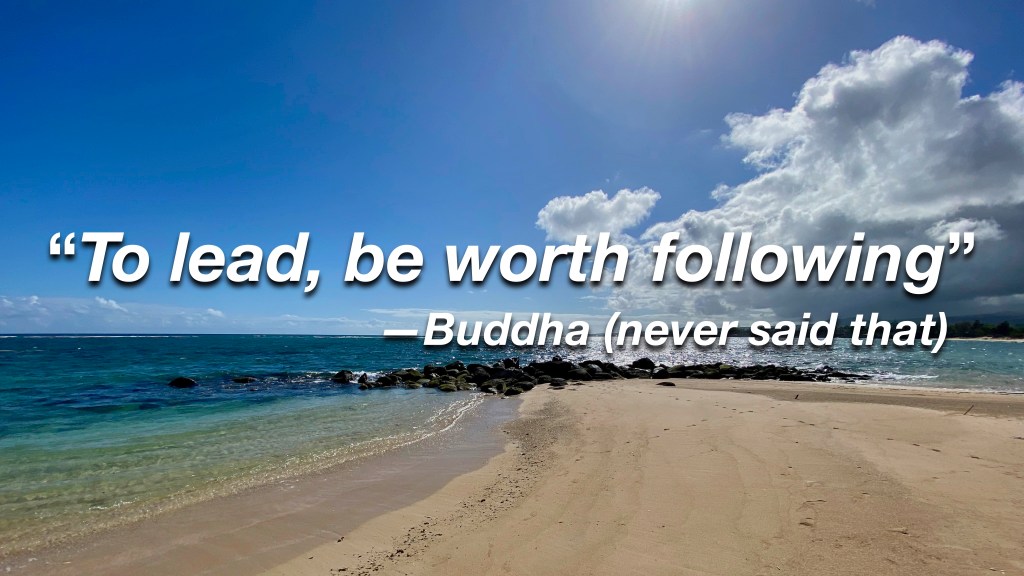
“To lead, be worth following.”
—The Buddha (never said that)
As a Buddhist, the essence of leadership is to truly understand that a leader is allowed to lead only because people choose to follow them. This shift in perspective away from our usual “self-centered” way of life to the realization: “I am here only because of other people allow me to lead…” is precisely what the Buddha taught about cultivating mindfulness, selflessness, and compassion in our unrepeatable lives through the Dharma of Non-Self (anatman).
In a non-profit, voluntary, and spiritual organization—like a Hongwanji Temple—the more people feel “they have to” do something for the temple, the less likely they will be active in temple services, activities, and events.
The more people feel “they want to” do something for the temple—because the temple provides value to them in return—the more they will be active supporters of the greater temple Sangha community of communities.
The Buddha taught the Truth of Impermanence: all things change. Once upon a time, hundreds of people would attend Sunday Services, and especially the Shinnenkai New Year’s Party!
Once upon a time, Makawao Hongwanji had plenty of members who “nevah go Sunday service” but would show up and help out at garage sale, bon dance, or help repair and maintain the temple grounds and buildings. We are blessed to have dedicated members who still do but the reality is there are less and less of them each year.
Once upon a time, “Going to church” on Sundays was expected and “being a member” was required to join the Hongwanji community of communities.
Times have changed. Today, the most active and fastest-growing communities are “affiliated organizations” like the BWA, the Scouts, the Cub Scouts, the Judo Club, Saturday Japanese School, and informal groups—which are not centered around attending Sunday service, which increasingly has fallen out of favor in America, especially for younger generations.
This is reality-as-it-is. What are we going to do? As leaders, all we can do is ask people to share their thoughts and feelings. “What can the temple do for you?” “What can the temple be for you?” “What do you like doing at the temple?”
Thus, leadership of a temple is less about what the temple needs from its members, and more about what the Sangha needs from the temple.
Our primary mission is to be a Buddhist temple, a religious organization, a center of spiritual growth and compassionate service to the community, a Sangha temple community of people drawn together by Kindness and Gratitude Beyond Words, NamoAmidaButsu!
At the same time, we are a human community—we come to Makawao Hongwanji because we feel like we belong, we fit in, we have a place.
As leaders, it is easy to focus on the “practical” aspects of temple “management”: fund-raising, repairs and maintenance of the physical assets of the temple, as well as the “emotional/nostalgic” aspects of “doing things like we’ve always done”.
It is much harder to re-imagine the temple as a truly welcoming and affirming place for everyone, a temple that truly reflects the differences and diversity of our Sangha, and this is what we must do, what we must aspire to be.
Buddhist Leadership: Mindful, Self-less, Compassionate
The Dalai Lama teaches that the heart of Buddhist leadership is Mindful, Self-less, and Compassionate.
Mindful: Listen First: Pay attention to what people are saying in words, and what they are saying without words. Think, feel, then act.
Self-less: It’s not about ME—It’s not about “My Ego.” Leaders worth following do the right thing; they do not need to “be right” all the time. Be mindful of the Ego-Self influences how we perceive others and ourselves.
Compassionate: strive to understand what people are feeling and thinking; what moves them, what motivates them, what inspires them?
His Eminence Monshu OHTANI Kojun gave every Hongwanji temple a scroll with hand-written calligraphy that says JI SHIN KYO NIN SHIN, “Receiving the Faith of Shinjin ourselves then teaching the Faith of Shinjin to others is the true way to repay our debt of gratitude to Amida.”
Let us aspire to take those words to heart, walk the path of Nembutsu in this unrepeatable life, gratefully receive the Faith of Shinjin ourselves, and then share what we have received with others. NamoAmidaButsu!
Mahalo piha to our new officers, directors, and advisors for assuming the burden of leadership. May your term of office be filled with aloha!
NamoAmidaButsu!
Rev. Kerry
(Originally delivered as the Dharma Talk for the Makawao Hongwanji Installation Service 2026)
 JUST SAY MAHALO®